Search exits: searches that ended the visit
A search that ends the visit usually means the results did not help.
For each site search term, how often it was the last thing done in the visit, how often people searched again and how often they opened a page.
Why quietstats: you get this without cookies, a consent banner or storing IP addresses, in every plan including Free.
In every plan, including Free. Behaviour and content.
📘 Step-by-step guide, with screenshots and diagrams →
Start free, no cardSee live demo
- No cookies or consent banner
- No IP addresses stored
- Groups under 5 visitors hidden
- 845-byte script
- Free plan, no card
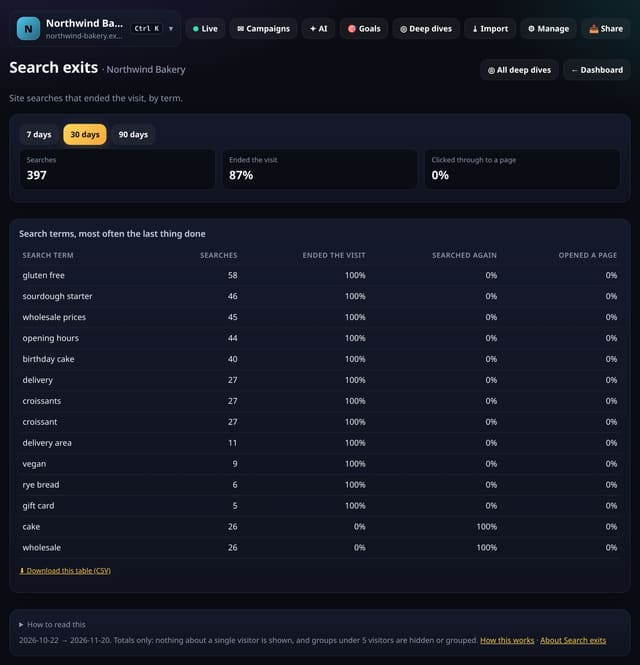
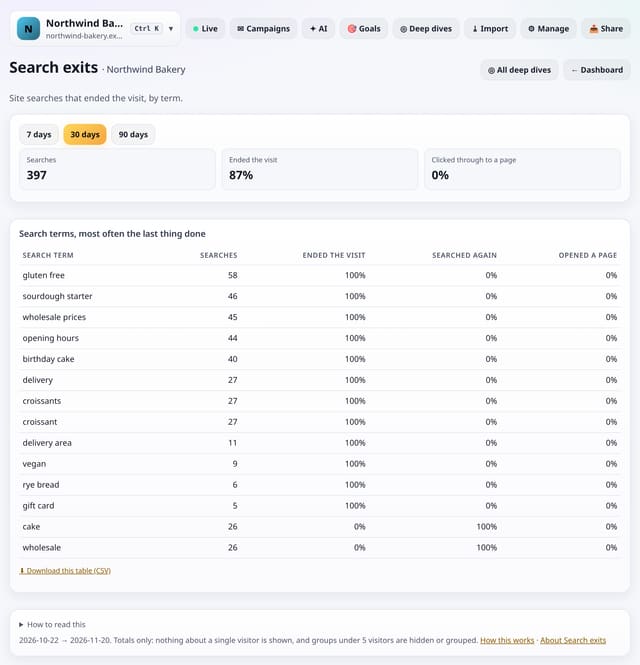
What it is
quietstats finds every site search in the range from the search parameter on your results page, and for each term used 5 or more times shows the share of searches that ended the visit, led to another search or led to a page.
Why it matters
A search that ends the visit usually means the results did not help. Terms with a high exit share are the pages, words or synonyms to add.
How it works
- Open your dashboard, go to Deep dives (or Reports on a phone) and open Analysis lab.
- Under Content, tap Search exits. You can also search for it on the All reports screen.
- Pick a date range (and any options at the top), read the “How to read this” notes, and download any table as CSV.
Privacy: what is and isn’t collected
Collected
- Nothing new: it reads the pageviews, events, goals or daily totals you already have
Never collected
- Anything about a single visitor
- Links between days: visitor ids still reset at midnight
- Cookies, localStorage or anything else stored on the visitor’s device
- IP addresses or user agents (used in memory, then discarded)
- Anything that links a visitor across days (the visitor ID resets daily)
Rows and limits
- Needs site search on your site (the q, s, search or query parameter)
- Search terms used fewer than 5 times are never shown
- Up to 92 days and 200,000 pageviews per screen
- Read from the database only when you open it, then kept for 10 minutes
“Rows” are database rows written, which is what our hosting is billed on. Reads are not rows written. Methodology →
Questions
How is this different from Search refinements?
Refinements shows what people searched next. This shows which terms ended the visit, the clearest sign of a failed search.
Does it store anything new?
No. It is worked out from the pageviews and events you already have when you open the screen, and only the totals are kept for 10 minutes.
Related features
Behaviour and contentSearch refinements: searches people had to repeat
Behaviour and contentSearches with no page: ideas for what to write next
Behaviour and contentAddress length: do short addresses do better?
Behaviour and contentAttention by hour: when visitors pay most attention
Behaviour and contentBounce rate movers: pages whose bounce rate really changed
Behaviour and contentScroll by screen size: do phones see your content?
Behaviour and contentSearch keywords from Google Search Console
Sources and campaigns
All behaviour and content features → · All features → · Docs: Search exits guide → · Compare features with other tools →
Guides on this topic
Set it up
Nothing to set up: it works with the standard one-line script.
<script data-host="https://quietstats.co.uk" data-dnt="true" src="https://quietstats.co.uk/js/script.js" id="YOUR_SITE_ID" async defer></script>Try it on your own site
Free during launch: one site and 5,000 pageviews a month, no card needed. After launch, paid plans start at £5 a month.