A/B tests with your own tags and a plain-English confidence note
Most A/B tools add a heavy script, cookies and a consent banner.
Compare two versions of a page, an email link or a message on any goal, and get a plain-English note on whether the difference is real or could be chance.
Why quietstats: you get this without cookies, a consent banner or storing IP addresses, in every plan including Free.
In every plan, including Free. Goals, events and conversions.
📘 Step-by-step guide, with screenshots and diagrams →
Start free, no cardSee live demo
- No cookies or consent banner
- No IP addresses stored
- Groups under 5 visitors hidden
- 845-byte script
- Free plan, no card
What it is
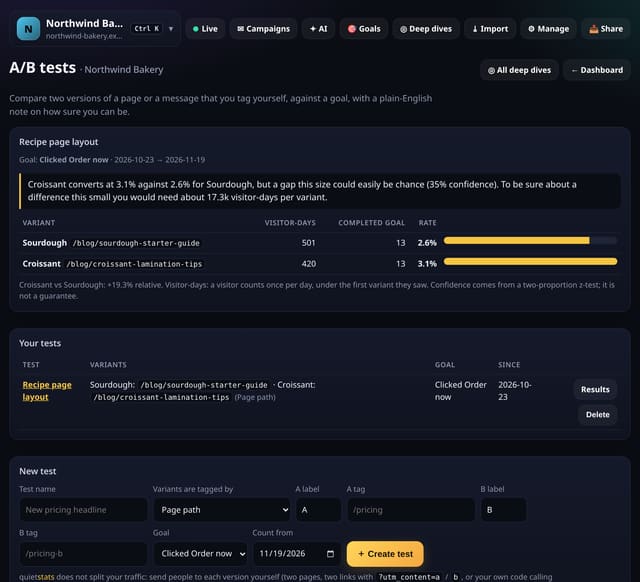
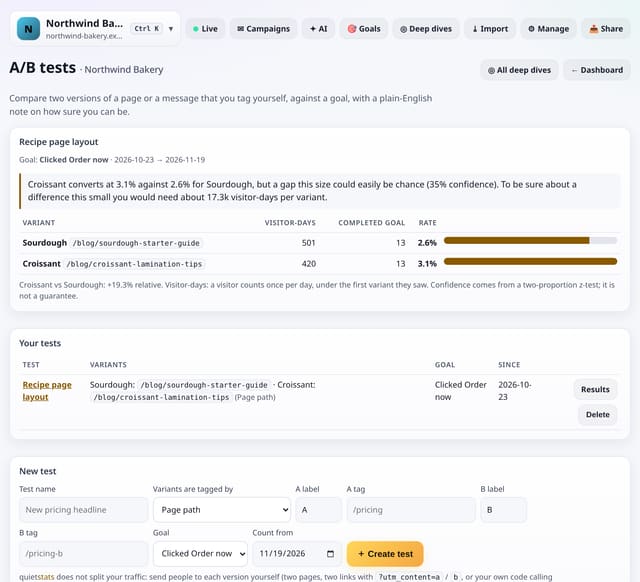
You run the two versions and tag them yourself: two page paths (/pricing and /pricing-b), two utm_content values on your links, or a Variant event from your own code with the events script. For the goal you pick, quietstats counts the visitor-days that saw each variant (the first one seen wins) and how many completed the goal later that day, shows each conversion rate and the relative lift, and runs a two-proportion z-test. The note says whether one version is probably better, only suggestive, or too close to call, and roughly how many visitor-days you would need to be sure.
Why it matters
Most A/B tools add a heavy script, cookies and a consent banner. If you can publish two versions, quietstats can tell you which one works, with no extra script and nothing stored about anyone.
How it works
- Set up the goal you care about (a page, event, click or form goal).
- Publish two versions and tag them: two paths, ?utm_content=a and ?utm_content=b on your links, or qs('Variant', 'B') in your code.
- Open Deep dives, choose A/B tests, create the test with both tags and the goal, then open its results.
Privacy: what is and isn’t collected
Collected
- Nothing new: pageviews, utm_content, custom events and goals you already collect
- One row per test: its name, tags, goal and start day
Never collected
- Which visitor saw which version
- Cookies or anything stored in the browser to keep a visitor on one version
- Cookies, localStorage or anything else stored on the visitor’s device
- IP addresses or user agents (used in memory, then discarded)
- Anything that links a visitor across days (the visitor ID resets daily)
Rows and limits
- quietstats does not split traffic: you choose who sees each version
- Visitors are counted per day (daily visitor IDs), so a person who returns on another day counts again
- Up to 10 tests per site; results use up to the last 92 days
- D1: results read the days since the test started when you open it, cached for 10 minutes; creating a test writes 1 row
“Rows” are database rows written, which is what our hosting is billed on. Reads are not rows written. Methodology →
Questions
How sure is “probably better”?
At least 95% confidence from a two-proportion z-test. Between 80% and 95% the note says the lead is suggestive, not conclusive.
Why “visitor-days”?
quietstats keeps no cookies, so a visitor ID lasts one day. Someone who comes back tomorrow is counted again, under whichever version they see first.
Can I test emails?
Yes: give the links in each email version a different utm_content and compare them on a goal.
Related features
Goals, events and conversionsUTM campaigns
Sources and campaignsCustom events and conversion rates
Goals, events and conversionsProduct performance: every product page from view to order
Goals, events and conversionsPages that help conversions
Goals, events and conversionsAuto-tracking v2: email and phone links, middle-clicks and CSS-class events
Goals, events and conversionsQR codes for posters and print: see what each one brings
Goals, events and conversionsPlain-English weekly insight
See your traffic
All goals, events and conversions features → · All features → · Docs: A/B tests with your own tags and a plain-English confidence note guide → · Compare features with other tools →
Guides on this topic
Set it up
<!-- Variant event (events script) on the page that shows version B -->
<script>qs('Variant', 'B')</script>
Replace YOUR_SITE_ID with the ID on your site’s settings page. Install guides →
Try it on your own site
Free during launch: one site and 5,000 pageviews a month, no card needed. After launch, paid plans start at £5 a month.