How to use address list checker: which pages had visits
Paste a list of page addresses and see which had visits in the range and which had none.
What it does
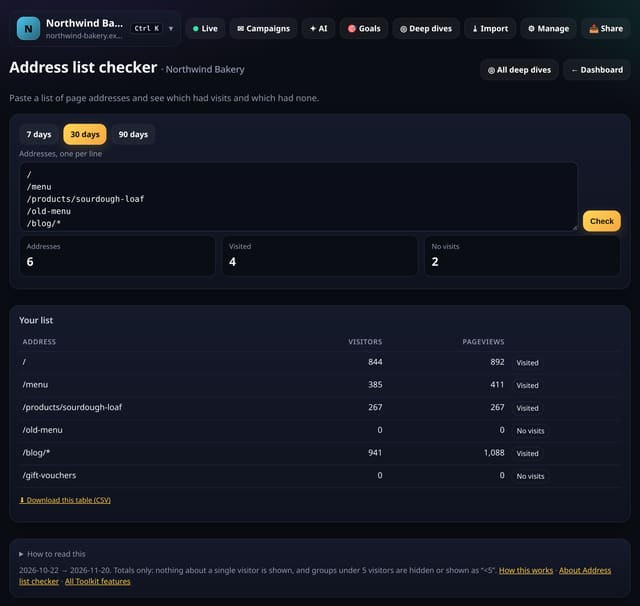
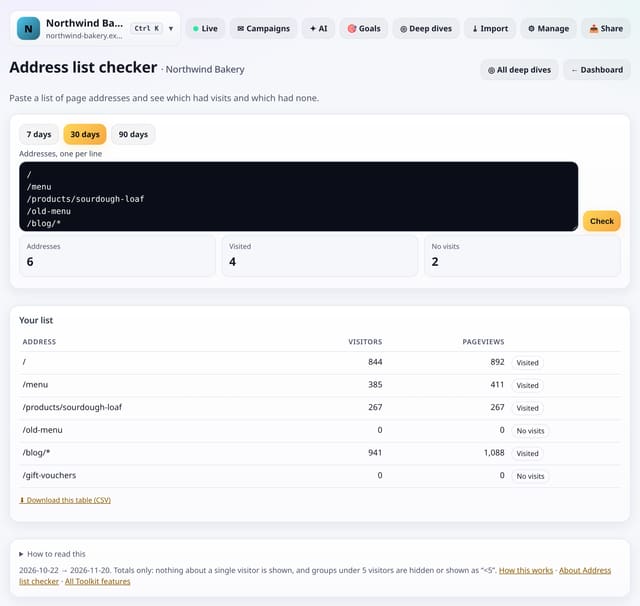
Paste addresses from your sitemap or a spreadsheet, one per line (full links or paths, and patterns like /blog/*). Each one is marked visited or no visits, with visitors and pageviews.
Why it matters
Sitemaps grow. A quick check shows which pages nobody reads, so you can improve, merge or retire them.
How to use it
- Open Toolkit → Look-ups → Address list checker, or search “Address list checker” on All reports (or go to /app/kit/urlcheck?site=YOUR_SITE).
- Paste your addresses into the box and press Check.
- The default range is 30 days; pick another at the top.
- Download any table with its CSV link; small numbers show as “<5” there too.
How it works
- Open your dashboard and choose Toolkit in the menu (or the Toolkit button on Deep dives, or search for it on All reports).
- Under Look-ups, tap Address list checker.
- Use the options at the top; nothing is saved unless you press a save button.
Privacy
- Collected: Nothing new from your visitors
- Not collected: Anything about a single visitor
- Not collected: Links between days: visitor ids still reset at midnight
- No cookies, and nothing stored on the visitor’s device.
- Reports show totals only: never a visitor list, IP address or single visit.
Limits
- Up to 100 lines
- Visitors under 5 show “<5”
- Up to 92 days and 200,000 pageviews per screen
- Read from the database only when you open it, then kept for 10 minutes
Plans
Every plan, including Free. quietstats is free during launch: the Free plan covers 1 site and 5,000 pageviews a month, and no card is needed. See pricing.
Questions
Does it collect anything new?
No. It works from the pageviews, events and goals you already have, read when you open the screen and kept as totals for 10 minutes. Groups under 5 visitors are never shown exactly.
Is the list saved?
No. It is only used for that check.
Related
Feature page: Address list checker: which pages had visits → What it is, why it matters, privacy and how other tools do it.