How to use API playground: build and try Stats API calls
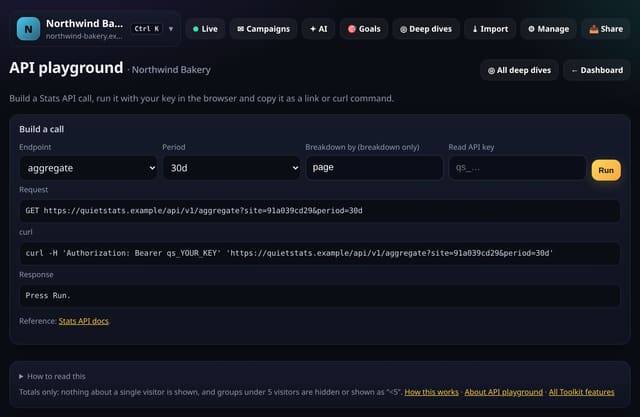
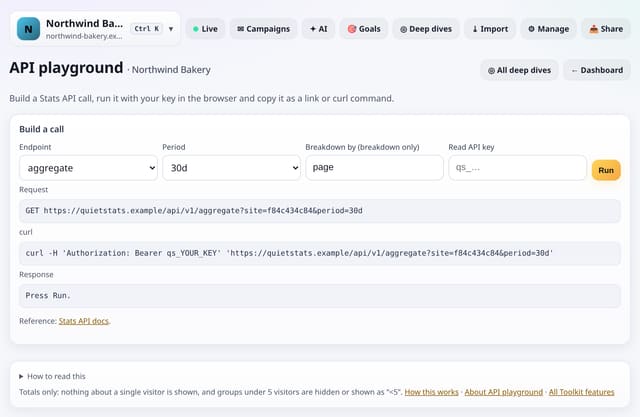
Build a Stats API call, run it with your key right in the browser and copy it as a link or curl command.
What it does
Choose an endpoint (aggregate, timeseries, breakdown, realtime or sites), a period and a breakdown. The playground shows the request and a curl command. Paste a read API key to run it and see the JSON reply. The key is only used for that request and is never saved.
Why it matters
APIs are easier to learn by trying them. The playground shows you exactly what to send and what you get back before you write any code.
How to use it
- Open Toolkit → Links, pixels and sharing → API playground, or search “API playground” on All reports (or go to /app/kit/apiplay?site=YOUR_SITE).
How it works
- Open your dashboard and choose Toolkit in the menu (or the Toolkit button on Deep dives, or search for it on All reports).
- Under Links, pixels and sharing, tap API playground.
- Use the buttons on the screen; nothing is sent anywhere.
Privacy
- Collected: Nothing new from your visitors
- Not collected: Anything about a single visitor
- Not collected: Links between days: visitor ids still reset at midnight
- No cookies, and nothing stored on the visitor’s device.
- Reports show totals only: never a visitor list, IP address or single visit.
Limits
- Needs a read API key from Settings
- The key is never stored by the playground
- Read from the database only when you open it, then kept for 10 minutes
Plans
Every plan, including Free. quietstats is free during launch: the Free plan covers 1 site and 5,000 pageviews a month, and no card is needed. See pricing.
Questions
Who else has this?
Plausible and Matomo have interactive API references. quietstats does it without cookies, IP addresses or following anyone over time: only counts from visits on the day.
Is my key saved?
No. It stays in the box on the page and is sent only with the request you run, to this site’s own API.
Related
Feature page: API playground: build and try Stats API calls → What it is, why it matters, privacy and how other tools do it.