How to use back-and-forth pages: returns and detours
Pages people come back to in the same visit (A → B → A), and detours that send people straight back where they came from.
What it does
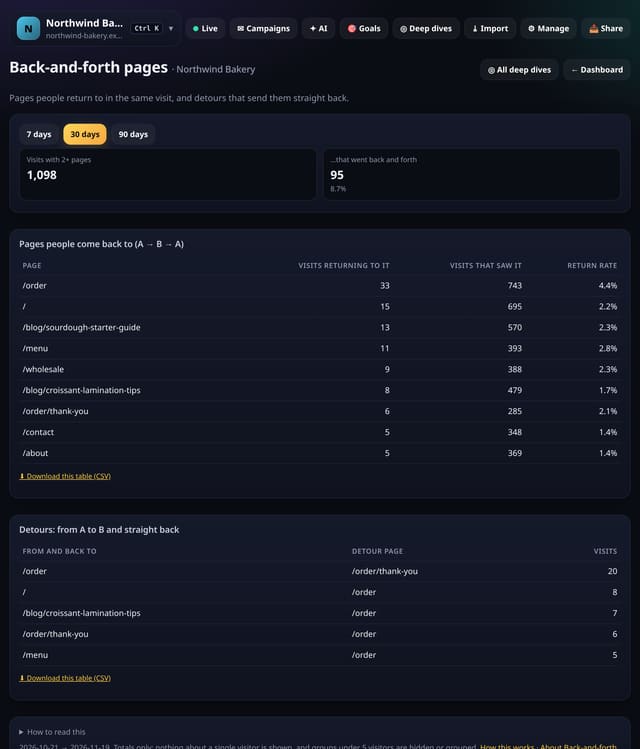
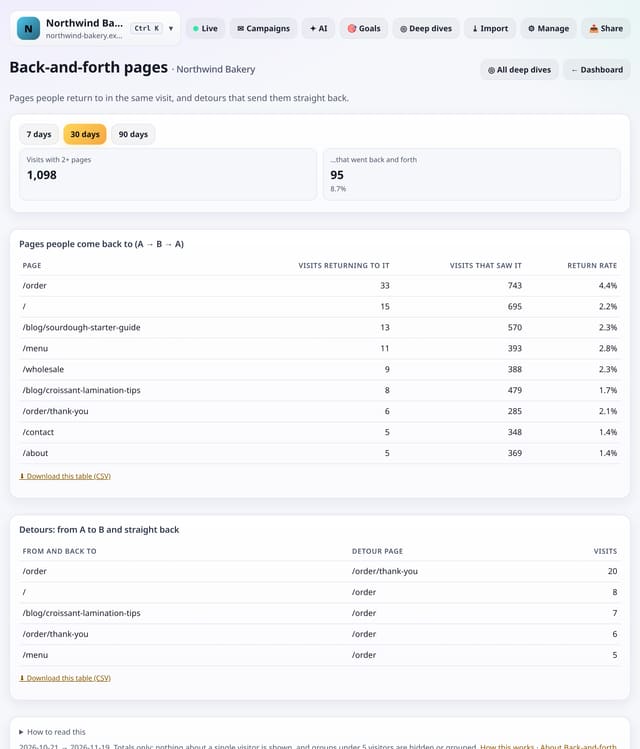
Within each visit, quietstats spots the pattern of going from page A to page B and straight back to A. It lists pages people return to, with how many visits returned, how many visits saw the page and the return rate, and the detours (A to B and back) with their counts. Anything under 5 visits is hidden.
Why it matters
A pricing table or a menu is meant to be returned to. A page people bounce straight back from may not answer their question. Both are worth knowing.
How to use it
- Open Deep dives → Analysis lab → Back-and-forth pages (or go to /app/lab/backforth?site=YOUR_SITE).
- Choose 7, 30 or 90 days; long-range trends read best at 90.
- Download any table with its CSV link; small numbers show as “<5” there too.
How it works
- Open your dashboard, go to Deep dives and scroll to Analysis lab.
- Under Content, tap Back-and-forth pages.
- Pick 7, 30 or 90 days (and any options at the top), read the “How to read this” notes, and download any table as CSV.
Privacy
- Collected: Nothing new: it reads the pageviews (and goals, events or speed checks) you already have
- Not collected: Anything about a single visitor
- Not collected: Links between days: visitor ids still reset at midnight
- No cookies, and nothing stored on the visitor’s device.
- Reports show totals only: never a visitor list, IP address or single visit.
Limits
- Counts under 5 visits are hidden
- Up to 92 days and 200,000 pageviews per screen
- Read from the database only when you open it, then kept for 10 minutes
Plans
Every plan, including Free. quietstats is free during launch: the Free plan covers 1 site and 5,000 pageviews a month, and no card is needed. See pricing.
Questions
Is a return a bad sign?
Not for hub pages such as menus, lists and pricing. It is a sign worth checking for the detour page, which people leave straight away.
Does a page refresh count?
No. The pattern needs a different page in between.
Related
Feature page: Back-and-forth pages: returns and detours → What it is, why it matters, privacy and how other tools do it.