How to use week ranking: how this week compares with the year
How each recent week ranks against the last 52 full weeks.
What it does
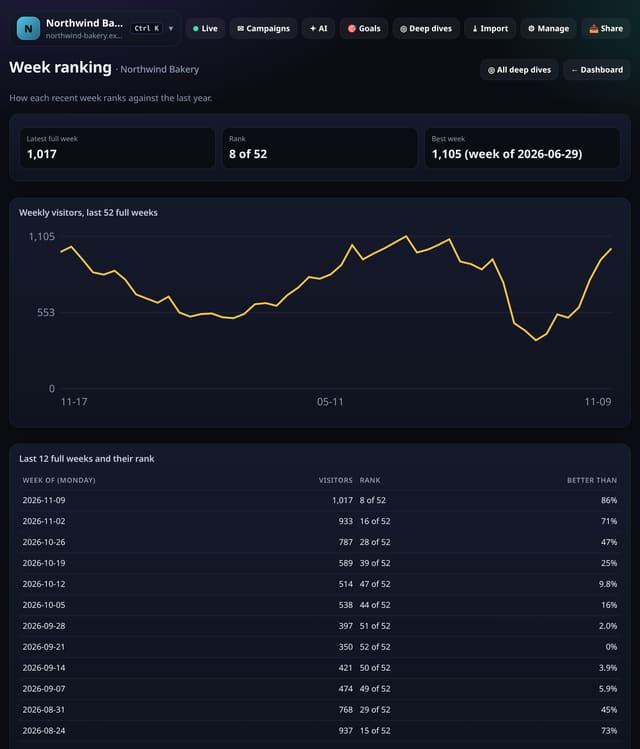
From daily totals (imported history included), quietstats adds up Monday-to-Sunday weeks, ranks the last 52 full weeks, and shows the last 12 with their rank and the share of weeks they beat, plus a weekly line chart.
Why it matters
“Our 5th best week this year” is easier for a client to understand than a percentage.
How to use it
- Open Deep dives → Analysis lab → Week ranking, or search “Week ranking” on All reports (or go to /app/lab/weekrank?site=YOUR_SITE).
- Download any table with its CSV link; small numbers show as “<5” there too.
How it works
- Open your dashboard, go to Deep dives (or Reports on a phone) and open Analysis lab.
- Under Tools, tap Week ranking. You can also search for it on the All reports screen.
- Read the “How to read this” notes, and download any table as CSV.
Privacy
- Collected: Nothing new: it reads the pageviews, events, goals or daily totals you already have
- Not collected: Anything about a single visitor
- Not collected: Links between days: visitor ids still reset at midnight
- No cookies, and nothing stored on the visitor’s device.
- Reports show totals only: never a visitor list, IP address or single visit.
Limits
- Needs four weeks of daily totals
- Reads no pageviews, so it is quick
- Uses up to 400 days of stored daily totals
- Read from the database only when you open it, then kept for 10 minutes
Plans
Every plan, including Free. quietstats is free during launch: the Free plan covers 1 site and 5,000 pageviews a month, and no card is needed. See pricing.
Questions
Why full weeks only?
A part week would always rank low. Only complete Monday-to-Sunday weeks are ranked.
Does it store anything new?
No. It is worked out from the pageviews and events you already have when you open the screen, and only the totals are kept for 10 minutes.
Related
Feature page: Week ranking: how this week compares with the year → What it is, why it matters, privacy and how other tools do it.